![Concrete accessibility ramp at a San Diego County home entry, BES Concrete [VERIFY image]](https://powayconcrete.com/wp-content/uploads/2026/07/bes-concrete-ada-accessibility-ramp-san-diego-county-scaled.jpg)
Concrete Accessibility Ramps in Poway & San Diego County
Right Slope, Proper Landing, Built to Be Safe
The 1:12 slope ratio, one inch of rise for every twelve inches of run, is the standard that makes a ramp safe and usable for a wheelchair or mobility aid. Get that wrong and the ramp is more dangerous than the step it replaced. BES pours accessibility ramps that meet the spec and hold up long-term.
Get a Free Ramp Quote
Tell us about the entry and the height difference. We respond same day, usually faster.
Concrete Accessibility Ramp Services for San Diego County Homes
Front entry ramps, side door access, grade transitions, and curb cuts, designed to the correct slope and built in concrete that holds up to years of daily use. One crew, one written quote, one price.
Front Entry Ramp
The most common project: converting front door steps to a gently sloping ramp so the entry is accessible without a step. We confirm the available run length against the height difference to verify a 1:12 grade is achievable in your available space before anything is quoted or started.
Garage & Side Entry Access
Side door or garage entries often have a single step or a small height change that becomes a barrier with age or injury. Concrete ramp additions at secondary entries are often simpler projects with shorter runs and can frequently be poured without disrupting existing concrete.
Pathway & Grade Transition
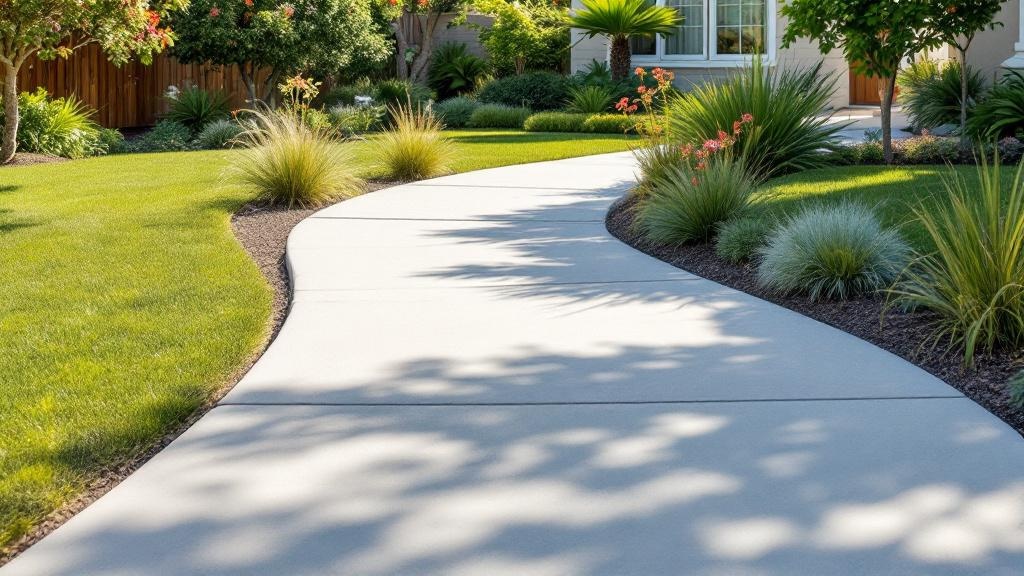
Sloped or stepped transitions within a yard between a driveway, patio, and home entry can be addressed with a graded concrete pathway that eliminates abrupt height changes. BES surveys the grade and designs a connected path that works with your existing landscape.
Curb Cut & Driveway Transition
A raised curb edge at the driveway or sidewalk transition can catch a wheelchair wheel or walker leg. We add or modify a curb cut to create a smooth transition. Detectable warning surfaces (truncated dome tile) are required at curb cuts in public-facing locations and are included where code applies.
1:12, Why Slope Is Everything
One inch of rise for every twelve inches of horizontal run. That is the 1:12 slope ratio, and it is not an arbitrary code number, it is the grade at which a wheelchair user can reasonably propel themselves up the ramp and control descent coming back down. Steeper than 1:12 and you have a hazard. Shallower, 1:16, 1:20, is better when your space allows it. BES measures the vertical rise at your entry and the available run length before writing a quote, so you know whether a compliant ramp is achievable in your space and exactly what it will require.
How BES Builds an Accessibility Ramp
Four steps, measured carefully at each stage. Getting the slope right is not optional, it is the entire point of the project.
Free On-Site Assessment & Grade Measurement
We measure the vertical rise from your entry level to the landing point, calculate the horizontal run required to achieve a 1:12 maximum slope, and confirm whether the available space accommodates a compliant ramp without switchbacks. You get a written scope and price before anything starts, including landing dimensions and any handrail framing if required.
Forming & Grade Setting
Getting a 1:12 slope consistent across the full ramp length requires careful form-setting. The cross-slope, the side-to-side tilt on the ramp surface, also needs to stay within 2% so the ramp does not push a wheelchair or mobility aid toward the edge. Both dimensions are set and checked in the forming stage before the concrete is poured.
Pour with Broom Finish
Ramp surfaces require texture. A smooth trowel finish on a sloped concrete surface is a slip hazard when wet. BES finishes all ramp surfaces with a medium broom texture that provides reliable traction for rubber-soled shoes, walker legs, and wheelchair wheels in San Diego’s rainy season. Detectable warning surfaces are installed where required by code.
Inspection & Handoff
We walk the finished ramp with you at completion. If the project involves a building permit, we coordinate the city inspection and are on-site for it. Curing instructions are written out, plan 7 days before regular foot traffic on a freshly poured ramp. Call Raymond directly with any concern after the job closes.
![Concrete walkway and accessibility path at a San Diego County home, BES Concrete [VERIFY image]](https://powayconcrete.com/wp-content/uploads/2026/07/bes-concrete-stepping-pad-walkway-san-diego-county.jpg)
What Makes a Ramp Actually Accessible
A ramp that looks right but has the wrong slope, a cross-slope that pushes a wheelchair toward the edge, or a landing too short to be usable is not an accessibility improvement, it is a concrete hazard. These are the specifications BES uses on every accessibility ramp project:
- Slope (grade)1:12 maximum, one inch of rise for every twelve inches of horizontal run. This is 8.3% grade. A steeper slope is harder to push a wheelchair up and poses a runaway risk on descent. Getting this exactly right is the single most important specification on an accessibility ramp.
- Cross-slopeThe side-to-side tilt across the ramp surface must not exceed 2% (1:48). A cross-slope steeper than 2% will cause a wheelchair to drift toward the low side and requires constant correction from the user or attendant.
- LandingsA level landing (max 2% grade in any direction) is required at the top and bottom of every ramp, and at any change in direction. Minimum 60 x 60 inches when a door swings toward the landing; 60 x 36 inches at ramp ends where no door is present.
- Ramp surface finishMedium broom finish perpendicular to the direction of travel. Provides traction for wet conditions without being so coarse that it catches wheelchair wheels or walker tips.
- Detectable warningsTruncated dome warning tile is required at curb cuts serving public sidewalks and at certain public-facing transitions. For private residential ramps away from public sidewalks, requirements vary, confirm with the City of Poway building department for your specific project.
- HandrailsHandrails are required when the ramp has a vertical rise exceeding 6 inches. Residential ramps often use metal post-set handrail systems installed alongside the concrete rather than embedded in it. BES sets anchor sleeves in the fresh concrete if handrails are part of the project scope.
Questions Homeowners Usually Have First
Cost, slope requirements, permits, legal compliance, color matching, and timeline. Straight answers, no pressure.
What does an accessibility ramp cost?
Concrete accessibility ramps typically run $1,500 to $5,000 for a standard single-entry ramp in the Poway and San Diego County area, depending on the vertical rise, total run length, landing size, and whether handrail anchors are included. Longer ramps with multiple switchback landings cost more. These are estimates, BES gives you a firm written number after measuring your entry at the free site visit.
What slope is actually required?
The 1:12 maximum slope ratio, one inch of rise per twelve inches of run, is the standard used in the ADA Standards for Accessible Design and in most residential accessibility guidelines. In practice, this means a 6-inch step height requires a 6-foot ramp run minimum. Shallower is always better if your space allows it: a 1:16 or 1:20 slope is easier for a self-propelled wheelchair user and reduces the risk on descent.
Does my home legally need to be ADA compliant?
The ADA governs public accommodations and commercial facilities, not private residences. Your home is not legally required to meet ADA standards. However, following ADA specifications for a residential accessibility ramp is simply good practice because those numbers reflect what actually makes a ramp safe and usable. Many homeowners also reference state building code requirements for residential accessibility, which in California are set out in the California Building Code.
Do I need a building permit?
Accessibility ramps are structural additions and typically require a building permit in the City of Poway and in unincorporated San Diego County. The permit process often includes a plan review to confirm slope compliance. BES handles permit application and inspection coordination as part of standard project scope. Do not skip the permit, a permitted ramp has documented slope compliance, which matters if the ramp is later used by a family member who is injured and liability becomes a question. Confirm specific requirements at the quote visit.
Can you match my existing concrete?
We can match the finish texture (broom, exposed aggregate, etc.) reasonably closely on new concrete, but color is harder to match exactly because new concrete cures lighter than existing concrete. We can note the discrepancy upfront so there are no surprises. If a perfect visual match is important, this is worth discussing at the site visit.
My parent needs this done soon, how fast can you move?
We understand that accessibility projects often have a real urgency behind them, a recent fall, a post-surgery discharge, a parent moving in. We cannot commit to a specific turnaround without knowing the project scope and current schedule, but when you call, let Raymond know the situation. BES tries to work out a realistic timeline at the quote visit, not weeks later.
A Poway Crew That Gets the Slope Right
BES Concrete has operated out of Poway since 2016. When you call about an accessibility ramp, you talk to Raymond, the same person who will come to your property, measure the rise and available run length, and tell you whether a compliant ramp is achievable in your space before any money changes hands. No dispatchers, no mystery subcontractors.
- Slope and cross-slope measured and confirmed before the quote is written
- Written quote is the price, no change-order surprises for unchanged scope
- Permit application and inspection coordination handled as standard
- Licensed (CSLB #1026938), insured, and BBB accredited since 2016
- Broom-finish texture standard on all ramp surfaces, not optional
- We walk the finished ramp with you before we leave
Concrete Accessibility Projects in Poway & San Diego County
Ramps, walkways, and accessible pathway work for homeowners across inland North County.
Questions Poway Homeowners Ask Before Calling
What slope does a concrete accessibility ramp need to be?
How much does a concrete accessibility ramp cost in Poway?
How long does a concrete ramp need to be for a 6-inch step?
Does my home need to be ADA compliant?
Do I need a permit to add an accessibility ramp in Poway?
What is a detectable warning surface and does my ramp need one?
Are handrails required on a residential accessibility ramp?
How long does it take to build a concrete accessibility ramp?
Related Concrete Services
Accessibility ramp projects often connect to walkway work, step replacement, or entry finishing. Same crew, same written-quote standard.
Let's Look at Your Entry
Free on-site visit to measure the rise and run, confirm slope feasibility, and give you a written quote before any work starts. No pressure, no obligation.
Licensed & insured (CSLB #1026938) · BBB accredited #1087327 · Serving all of San Diego County from Poway